
✓ Written & medically reviewed by Dr. Molly McDonald, PT, DPT, LMT · Updated May 2, 2026
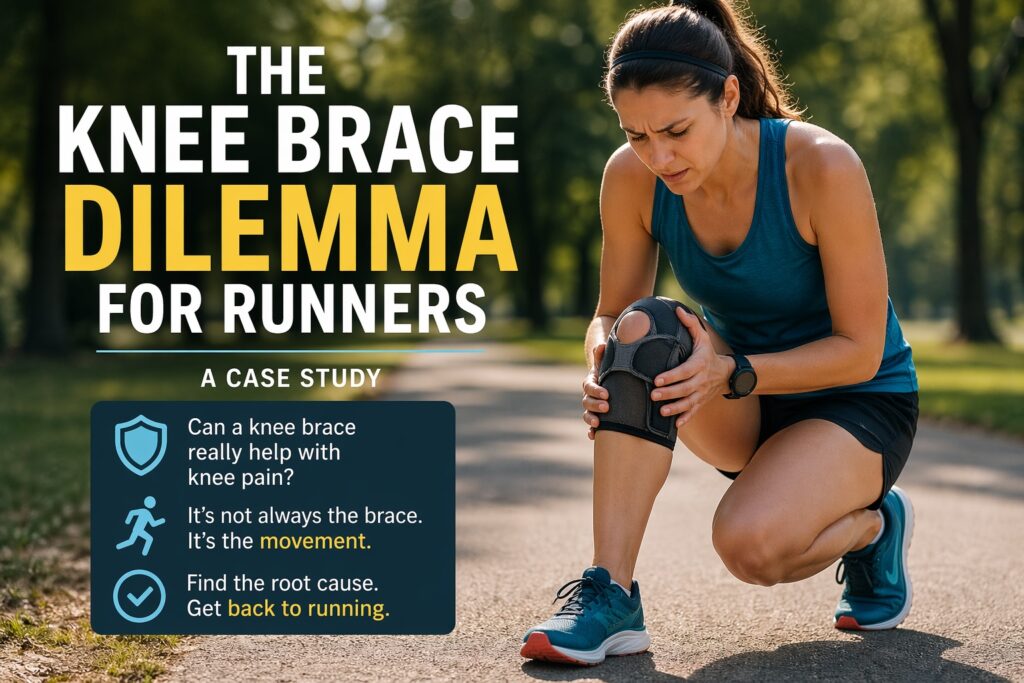
One of the most common questions I hear is some version of: Can you run with a knee brace? Should I run with a knee brace? Will it actually help?
Honestly, the answer depends on what's causing your pain. And the best way I can explain it is through Rebecca's story.
Watch this article as a video:
Rebecca is in her mid-30s and has been running for years. For her, it's not just exercise — it's her meditation. Her essential wind-down from stress. So when her knee started hurting, she did what most dedicated runners do: she pushed through it.
That didn't go well.
The pain escalated to the point where she couldn't sit at her desk and straighten her leg without intense discomfort. She stopped running entirely, which brought its own wave of frustration and emotional toll — but even rest didn't resolve it. X-rays came back clean, which left her feeling anxious and without answers.
So she tried a knee brace she found online. It didn't truly fix anything, but it gave her the feeling of doing something — and sometimes that's enough to keep going. Weeks passed. Nothing improved. Finally, she came in for an evaluation.
During her walking assessment, her knee looked stable in the brace. Seemed promising.
Then she started running — and the problem was immediately obvious.
With every stride, her knee was collapsing inward. And here's the critical piece: the brace wasn't strong enough to stop it. It was offering compression and a sense of support, but it couldn't correct the underlying movement pattern driving her pain.
That's the thing about running with a knee brace. A standard brace can manage discomfort temporarily, but if your pain is caused by a mechanical issue — like your knee caving inward mid-stride — it simply can't exert the force needed to fix what's actually going wrong.
The answer is "It depends".
If you're dealing with knee pain while running, and are wondering if a brace helps, don't ask yourself "Which brace should I buy?", but "What is my knee actually doing when I run — and why?"
That's a question worth getting answered properly. A professional movement assessment can identify the root cause. More often than not, it's something fixable! Something that lets you get back to running — not by relying on a brace indefinitely, but by actually resolving the problem.
Rebecca did exactly that. You can too. Come in for an assessment at my Cypress, Texas office and let's figure out what's really going on.
Ready to move without pain — without meds, injections, or surgery?
Talk with Dr. Molly and get a clear next step for your specific goal.
Request Cost & AvailabilityRequest a Free Discovery VisitReal results from active adults in Cypress, TX
“Dr. Molly has done an outstanding job restoring my leg/hip strength levels to pre-2020 levels in less than a year. I am a competitive powerlifter and am back to deadlifting over 400 lbs.”
“I’m a 39-year-old runner who reached out to Dr. Molly with a nagging knee issue. She gave me several exercises to help alleviate my pain — and once I followed her plan, things turned around.”

About the author
Owner & Physical Therapist, Your Goals Physical Therapy — Cypress, TX
Molly helps active adults end nagging aches and pain and get back to the activities they love — without medication, injections, or surgery. She treats the root cause, not just the symptom, because you shouldn’t be told you can’t do something; you should be shown how.
